
Echoes of the Common Era is a cluster of seven essays that opens a single question: why does the sense and language of a “new era” intensify everywhere at the same time. Security, climate, technology, the economy, and media all appear to be shifting simultaneously, yet they are still described using a language that assumes situations are governed by individual or institutional control. As decisions become conditioned — as rhythms, limits, and systems begin to matter more than intentions — a phenomenon emerges that this series follows closely: structure begins to speak.
The series develops a language through which this shift in layers can become speakable. It traces how human agency emerged historically, how it reached its peak during the Age of Interpretation, and why it now encounters its own limit — not because “people have changed,” but because the conditions of the environment have changed. The aim is deliberately modest: to make visible what many already sense, but struggle to articulate without the language slipping into panic or over-explanation.
Below are the seven essays that form the cluster. Together they follow an arc from opening to closure: the first initiates the inquiry, the last brings it to rest.
1) AGE OF STRUCTURE

The series begins in the present moment. The phrase “a new era” now recurs everywhere, yet it has not solidified into a concept. The essay shows that the phrase functions as a probe—an attempt to name something that does not appear in isolated events, but in the conditions that lie behind them. As politics turns into reaction, climate sets hard limits, technology accelerates, and media reshapes the rhythms of attention, something shared begins to make itself heard. That shared element is not an opinion, but a structure: the set of conditions that determines what can be done.
2) BIRTH OF AGENCY

The second essay returns to the origin of agency: how the human learned to distinguish itself from its environment, to name, to choose, to carry responsibility—and to build a world around the “I.” Agency is not treated here as a natural given, but as a historical solution through which humans learned to operate in a world of signs, norms, and narratives. At the same time, the essay reveals the double nature of agency: it liberates, but it also binds—because it makes the human the one who must “solve” the world. This background makes it intelligible why agency begins to tighten precisely now.
3) WORLD OF SIGNS

The third essay names the turning point at which the world became readable: signs detached from things and began to form an order of their own. Once the world can be written, measured, and classified, a fundamental mode of control emerges—reality appears as a text whose correct reading produces power, order, and continuity. The essay shows how the logic of sign and law lays the foundation for later layers—institutions, narratives, and interpretations. At the same time, it makes visible that the “voice of structure” does not arise from nothing: it has been present from the beginning, but for a long time it moved in alignment with human agency.
4) MOVEMENT OF HISTORY

The fourth essay moves to the level of narrative: how reality begins to organize itself as a movement of history, in which past and future carry one another. Narrative is not treated here as entertainment but as structure—a way of binding communities together, giving direction, justifying sacrifice, and sustaining the expectation of resolution. The essay also shows why a narrative that grows toward universality inevitably begins to fracture: the same plot cannot remain intact everywhere without different contexts pulling its form into view. From this tension, the next layer emerges—interpretation.
5) BURDEN OF LANGUAGE
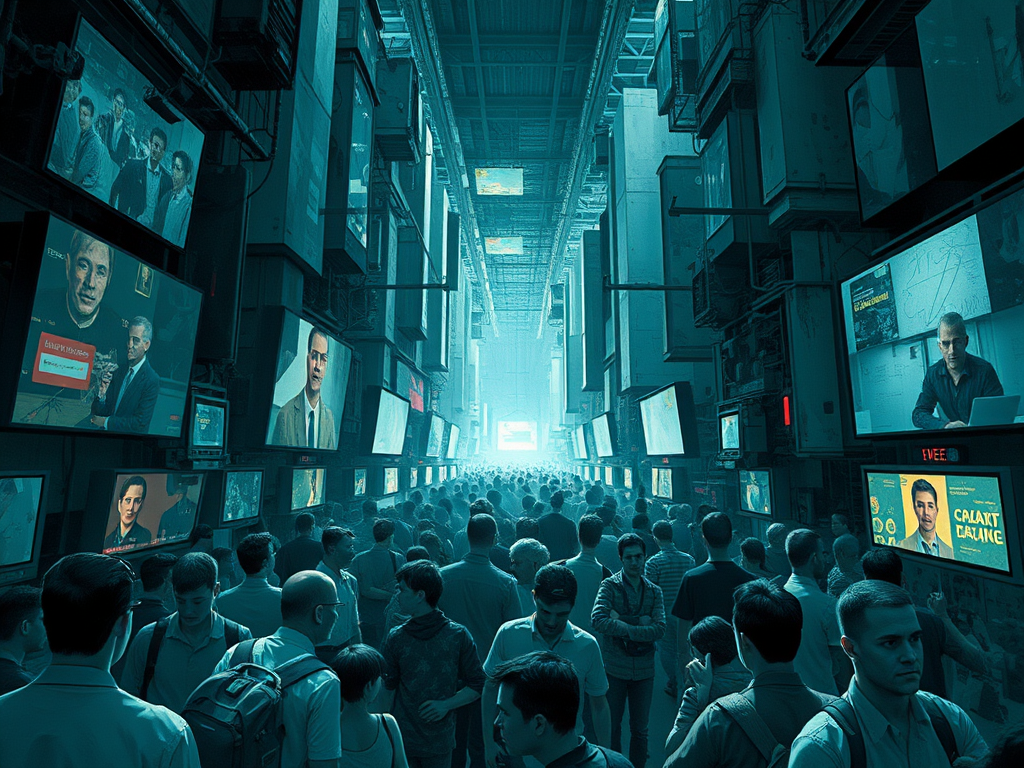
The fifth essay shows how interpretation became both a liberation and an obligation. When a shared measure fractures, meaning must be continuously produced anew: justified, explained, defended, corrected. The language of interpretation expands until it permeates everything—politics, science, culture, personal identity—and at the same time it begins to overload. The essay does not describe this in the language of pathology, but as a structural consequence: when the conditions of the environment change, interpretation attempts to carry not only meaning, but also what no longer behaves like narrative at all, but like constraint. From this emerges a peculiar tension of our time: more meaning is produced than ever before, yet a shared language becomes increasingly difficult to sustain.
6)LANGUAGE MIRROR

The sixth essay introduces an instrument no one expected to appear at this point in history: the language model. It does not arrive as a “savior,” but as the culmination of the Age of Interpretation—a continuation of the linguistic turn in which language becomes aware of its own structures and begins to be modelled. The LLM does not solve problems or bear responsibility, but it does something decisive: it reflects the structures of language back to us in a form that can be jointly observed. When structure becomes speakable, the overheating of interpretation itself begins to take on an explicable shape.
7) VOICE OF STRUCTURE

The seventh essay closes the cluster by asking what follows when structure is no longer a background condition but becomes audible. Once a mirror exists, agency can no longer pretend to be independent of its conditions—and for that very reason agency often tightens its grip: control accelerates at the same moment that uncontrollability is revealed. The essay does not end in optimism or dystopia, but in a name: the voice of structure is heard when the world begins to speak through constraints. This completes the arc of the series and leaves the reader in a different posture—not asking “what do I believe,” but “within what structure do I live.”