Time as the medium of structure
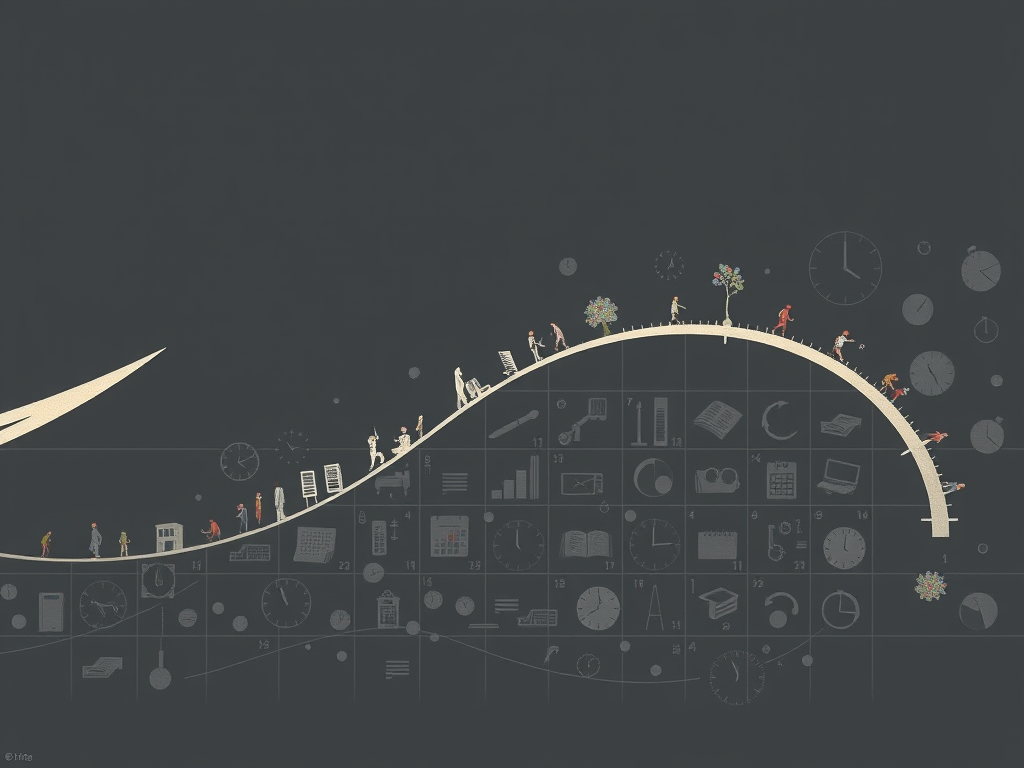
Structure Research Studio approaches time with a simple but demanding hypothesis:
Time is not just a neutral container for events. It is the medium in which structure becomes visible.
This hypothesis sits on the same epistemic ground as Architecture of Meaning and A Tale of a New Era:
- that human history can be read as a multi-millennia narrative arc,
- that individual lives follow structurally similar arcs on a smaller scale,
- and that meaning arises where movement and mechanism intersect.
“Structure & Time” as a category takes up one of the Studio’s core themes: Movement & Mechanism – the idea that any adequate account of time must hold together:
- time as movement – the lived, continuous flow of experience,
- time as mechanism – the segmented, measured, engineered time of calendars, clocks and schedules.
The central question is not which is “more real”, but what happens when mechanisms are built on top of a movement they cannot fully control.
Movement: time as lived arc
Before there were clocks or calendars, there were arcs:
- the arc of a day from dark to light and back
- the arc of a season from seed to harvest
- the arc of a human life from dependence to agency to frailty
These arcs are not abstractions; they are felt sequences.
They provide the first, pre-theoretical sense that reality has:
- a before that can no longer be accessed,
- a now that must be traversed,
- an after that remains open and dangerous.
This is what A Tale of a New Era treats at a civilisational scale: history as an arc from early symbolic consciousness to law, to temple, to text, to interpretation, and now toward structure.
Movement, in this sense, is:
- continuous rather than discrete,
- qualitative rather than purely quantitative,
- organised in phases rather than in identical units.
We experience it as a tension between what has already taken form and what is still becoming.
Mechanism: time as engineered instrument
Mechanisms enter when movement is no longer enough.
Calendars, clocks and later time-zones and schedules transform flow into countable segments:
- days into dates,
- seasons into quarters,
- lifetimes into milestones,
- history into timelines and periods.
Mechanised time allows:
- coordination at scale,
- economic planning,
- scientific measurement,
- and, eventually, digital synchronisation.
In the Architecture of Meaning this belongs to the upper layers: the frameworks and grids that organise action across large systems. Mechanism is not an enemy of movement. It is what allows societies to act together inside the flow. But it introduces a risk characteristic of the Interpretation paradigm:
The instrument begins to be mistaken for the reality it measures.
What was originally a way of navigating movement becomes a normative frame:
- life is judged against schedules,
- organisations are judged against quarterly cycles,
- histories are judged against developmental narratives.
Time becomes something we “manage” rather than the medium in which we are carried.
The fracture: when mechanism overrules movement
The friction between Interpretation and Structure paradigms can be felt most sharply at this fracture point.
In the Interpretation paradigm:
- time is a resource to optimise,
- a stage for identity narratives (“where I should be at this age”),
- a canvas for self-improvement plans and productivity systems.
When mechanisms dominate, characteristic distortions appear:
- Oversaturation – more tasks and projects than the underlying human or institutional structure can bear.
- Temporal anxiety – the sense of always being late, behind, or “out of sync”, regardless of actual conditions.
- Narrative compression – complex arcs are squeezed into short cycles, producing repetitive crises and premature “resolutions”.
These are not primarily psychological problems. They are structural mismatches between movement and mechanism. In that light, the question for an Era of Structure is not:
“How can we manage time more efficiently?”
but rather:
“How can mechanisms be re-aligned with the real movement of the systems they govern – individual, organisational, historical?”
Time as the medium of structure
The Studio’s working definition is:
Structure is how movement holds together over time.
A pattern that repeats once is an event. A pattern that persists across days, years or centuries becomes a structure.
This applies at several scales:
- Micro (the person) Sleep cycles, attention spans, life phases – all show arcs that cannot be redesigned at will without cost.
- Meso (organisations and institutions) Product lifecycles, funding rounds, political terms and generational turnover each impose their own temporal structures.
- Macro (civilisational arcs) The large-scale movement traced in A Tale of a New Era – from the Age of the Sign to the proposed Era of Structure – suggests that even our deepest epistemic habits come in long waves.
To attend to structure is, therefore, to attend to time-form:
- Where are we in the arc?
- Which phase are we in – emergence, escalation, crisis, resolution, aftermath?
- What kinds of moves are structurally possible at this point, and which belong to other phases?
These questions anchor the Studio’s research into Structure & Time.
From theory to instruments
Within this category, Structure Research Studio is less interested in time as a metaphysical puzzle, and more in instruments that:
- reveal mismatches between movement and mechanism,
- help organisations and individuals locate themselves in their real arc,
- and test what happens when mechanisms are adjusted to fit structure, not the other way around.
This intersects directly with other strands:
- with Narrative Systems, where time is configured as plot;
- with LLM & Language, where interaction with models is often an attempt to compress or stretch time;
- with Cultural Signals, where film and media display intuitions of being “out of time” or “at the end of something”.
Structure & Time will be the place where these threads are tied back to the fundamental aihio of Movement & Mechanism – and to the claim that any serious talk of a “New Era” must be matched by a serious account of how time itself is structured.