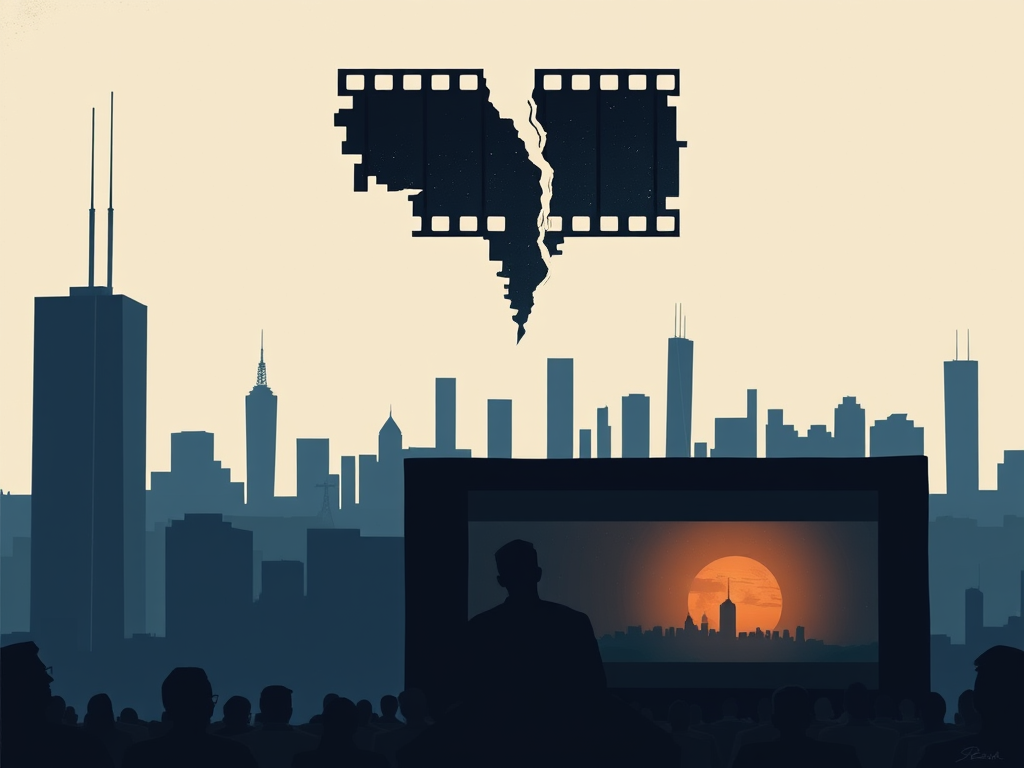
When paradigms shift, culture often moves first. Art begins to register pressures that theory cannot yet name.
Around the turn of the millennium – roughly 1998–2001 – a dense cluster of cultural signals appeared. They did not announce a “New Era” in clear language. Instead, they carried a shared mood: something in the structure of reality feels wrong, even if everyday life still runs on the old assumptions.
From the perspective of Structure Research Studio, this short period forms a kind of seismograph reading: a record of how the transition from an Interpretation paradigm toward a Structure paradigm was already being felt, long before it could be articulated.
The last calm: surface optimism, structural fatigue
On the surface, the late 1990s in the West were framed by familiar narratives:
- the “end of history”
- the victory of markets and liberal democracy
- the promise of a frictionless digital future
Beneath that optimism, several structural tensions were already present:
- networked finance and information systems increasing speed and coupling
- fragile global supply chains and just-in-time logic
- growing cognitive load and early signs of attention saturation
Public discourse, however, still handled these pressures mostly in Interpretation-era language: individual stress, personal meaning, lifestyle choices, identity. The system was changing. The vocabulary was not.
Films as early structural “flash photography”
Cinema around the millennium acted as a sensitive surface for these tensions. A number of widely seen films returned, again and again, to the same underlying image: a protagonist trapped inside a structure that defines reality itself.
- Reality as simulation or script
- Everyday life as a constructed set
- The self as a role maintained by an invisible system
Whether the setting was digital, suburban, or dreamlike, the feeling was similar:
“What if the real conflict is not between characters, but between a human life and the structures that already script it?”
These works did not yet offer a stable theory of structure. They staged an intuitive protest against unseen architectures – algorithms, corporations, media systems, social masks – that seemed to shape choices before they were made. The audience response mattered. Viewers recognised themselves in the sensation of:
- living in something
- being lived by something
- without good language for either.
This is a classic moment of paradigm friction: the experience belongs to the emerging paradigm, while the available explanations still belong to the old one.
Millennium and twin towers: two different “events”
The transition from the 1900s to the 2000s carried an explicit technological anxiety in the form of Y2K. The fear was simple and mechanical: what if the code fails? When the clocks rolled over and nothing catastrophic happened, the relief was also framed mechanically: the bug had been fixed, the system was safe.
Less than two years later, the image that would dominate the early 2000s was no longer that of a software glitch, but of two physical structures collapsing in real time.
The attacks on the World Trade Center functioned at several levels:
- a geopolitical rupture
- a symbolic strike on global finance
- a visual demonstration of structural failure
For many, the event shattered the sense of being protected by stable architectures – political, economic, spatial. The towers had stood as icons of a particular order; their fall condensed fears that had already been circulating in less precise forms. Culturally, 9/11 was not only an attack. It was an involuntary image of a paradigm at its limit.
Culture reacting before articulation
Seen in retrospect, the late-millennium signals share a pattern:
- A growing suspicion of surfaces Everyday normality is treated as a thin layer hiding a more decisive system underneath.
- Characters looking for exits from structures, not just situations The desire is not only to solve problems, but to step outside the framework that defines what counts as a problem.
- An undercurrent of exhaustion with interpretation Irony, self-awareness and commentary reach saturation. More analysis does not resolve the unease.
All of this takes place before a clear Structure vocabulary exists.
Culture reacts through:
- images of collapse and awakening
- stories of simulated realities and broken scripts
- a noticeable darkening of tone in mainstream entertainment
The Interpretation paradigm is still dominant, but its tools – therapy language, lifestyle advice, productivity techniques – begin to feel insufficient. The audience feels the mismatch before any coordinated theory of “structure” is on the table.
From signal to vocabulary
For Structure Research Studio, these cultural signals are not curiosities of film history. They are:
- early indicators of an emerging Structure paradigm, and
- reminders that paradigms are lived first and named later.
Today, large language models sit at another boundary point. They are introduced into everyday life with the same old promises:
- more control over time
- more refined self-presentation
- more efficient performance inside existing systems
The millennium taught that such promises can mask deeper structural fatigue. The Studio’s work with tools like the Structure Vocabulary Builder proceeds from this lesson:
- cultural signals around 2000 show that people had already begun to feel the limits of the Interpretation paradigm;
- the present task is to provide a language in which that feeling can be worked with, rather than simply recycled as anxiety or spectacle.
In this sense, analysing late-millennium cinema and the imagery of 9/11 is not nostalgia. It is an attempt to understand how culture reacts before articulation – and to offer, this time, a more adequate vocabulary before the next wave of structures fails in public.