On recognising reality as something that behaves like a story
Across philosophy, psychology, literary theory and even marketing, one claim has quietly become common ground:
Human beings make sense of the world narratively.
Jerome Bruner spoke of “narrative modes of thought”. Paul Ricoeur analysed how time becomes understandable only when configured as a story. Historians from Hayden White onward have shown how even “objective” history relies on plot shapes: tragedy, comedy, romance, irony. In other words, the language of narrative is already at the centre of our discourses.
And yet, there is a blind spot. We comfortably say that people tell stories about themselves, but we hesitate to say that history itself behaves like a story, or that the reality we inhabit has a narrative structure. We treat narrative as a way of talking about life, not as a way of noticing how life already organises itself.
Narrative Systems, as a research track inside Structure Research Studio, begins exactly there.
Narrative as the default operating system
In everyday speech, narrative is not a specialised technique. It is the default setting.
- We introduce topics by creating a before: “Earlier today…”
- We mark turning points: “And then suddenly…”
- We move toward resolution: “In the end it turned out that…”
Even small exchanges have a dramatic skeleton:
- a situation is set
- some tension is introduced
- something shifts
- the tension is released or postponed
This pattern organises:
- personal anecdotes
- news articles
- business case studies
- therapy sessions
- political speeches
We already live inside a narrative system. We simply rarely name it as such.
Why we rarely apply this to “reality itself”
When narrative vocabulary is moved from “stories we tell” to “the world we live in”, several fears arise:
- Fear of relativism If history is “just a story”, does anything matter? Does truth disappear?
- Fear of manipulation If reality is narratively shaped, is everything simply propaganda?
- Fear of loss of objectivity Disciplines built on data and measurement worry that narrative talk will erase their hard-won methods.
These fears are understandable. They have also had a blocking effect: they keep the narrative insight confined to psychology, literature and communication, while history, economics and everyday reality are still described as if they were simply collections of facts plus individual interpretations.
The Studio’s hypothesis is different:
Narrative talk does not make reality unreal. It reveals that events, institutions and personal lives already behave like stories – with beginnings, tensions, turning points and resolutions – long before anyone writes them down.
When language itself is dramatic
If narrative is not an optional lens but part of the architecture of language, then each act of speaking already participates in a dramatic logic.
- Statements position a now in relation to a before and an implied after.
- Explanations choose villains, victims, heroes or systems as carriers of conflict.
- Plans organise the future as a promised resolution to today’s tension.
In this sense, the structure of language is itself dramatic: our utterances are small acts in an ongoing plot.
A simple example:
“We have always done it this way, but it is no longer working.”
In one sentence:
- the past is stabilised (“always”)
- the present is marked as crisis (“no longer working”)
- a demand for a turning point is smuggled in
- the future becomes an open question
Narrative is not an embellishment; it is the way time, tension and agency are woven into grammar.
What changes when we attend to “the story we are in”?
If we accept that reality behaves narratively, not only individually but collectively, a practical shift follows:
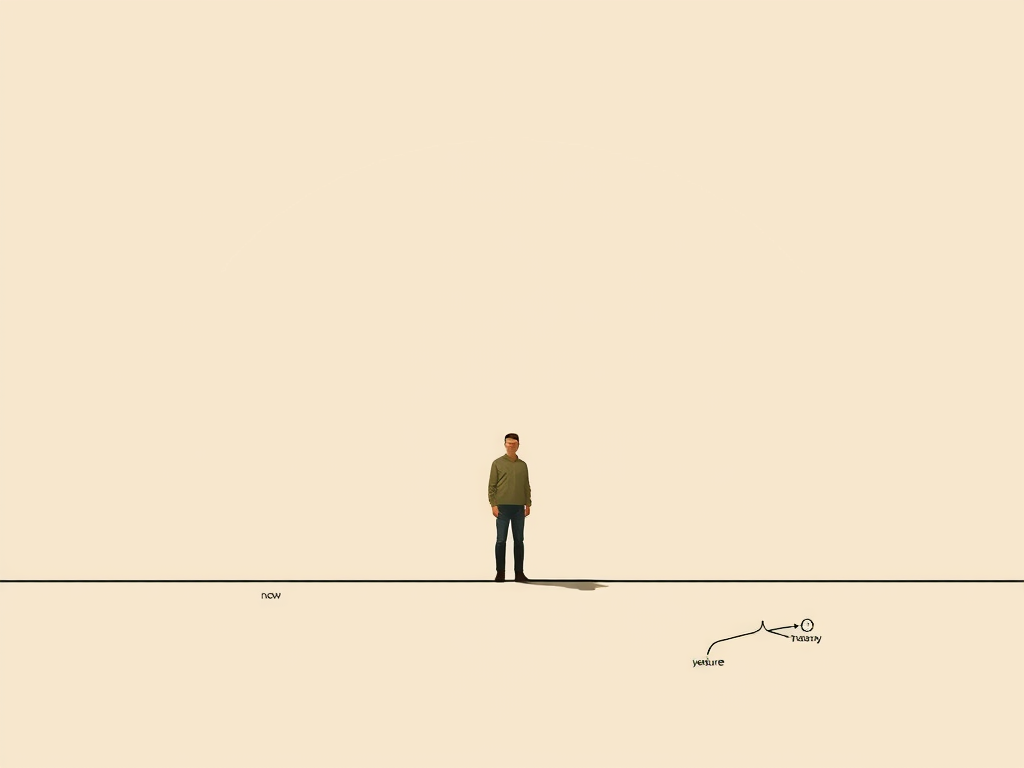
- Now The present moment is no longer just “how things are”. It is recognised as a scene inside a larger arc: not the whole story, but a particular act with its own logic.
- Yesterday The past is not just a storehouse of facts, but a set of plot choices: which events have been made into turning points, which have been treated as background noise, which threads were prematurely declared “resolved”.
- Tomorrow The future is not empty space, but a field of competing storylines waiting to be chosen, resisted or re-written: progress narratives, collapse narratives, salvation narratives, steady-state narratives.
Paying attention to the story we are in does not mean inventing a myth and living inside it. It means learning to see how narrative logic is already shaping:
- what we treat as possible,
- which crises we recognise as crises,
- and which outcomes we consider “natural”.
Do we need more theory?
Narrative theory, cognitive narratology and discourse analysis have produced a rich library of concepts. The Studio draws on this work where it clarifies:
- how plots compress time
- how metaphors frame agency
- how genres (tragedy, comedy, apocalypse) organise expectation
At the same time, the central observation is deliberately simple:
We already speak in stories. What we have not yet done is treat history, institutions and shared reality as narrative systems in their own right.
Narrative Systems as a category in this journal will therefore focus less on adding theoretical layers, and more on:
- mapping recurring plot structures in public life,
- examining how LLMs learn and reproduce these plots,
- and designing experiments that test what happens when the underlying story-logic is made visible instead of remaining implicit.
In an Era of Structure, recognising narrative systems is not an invitation to escape into fiction. It is a way of seeing the frameworks that quietly decide what can and cannot happen next.