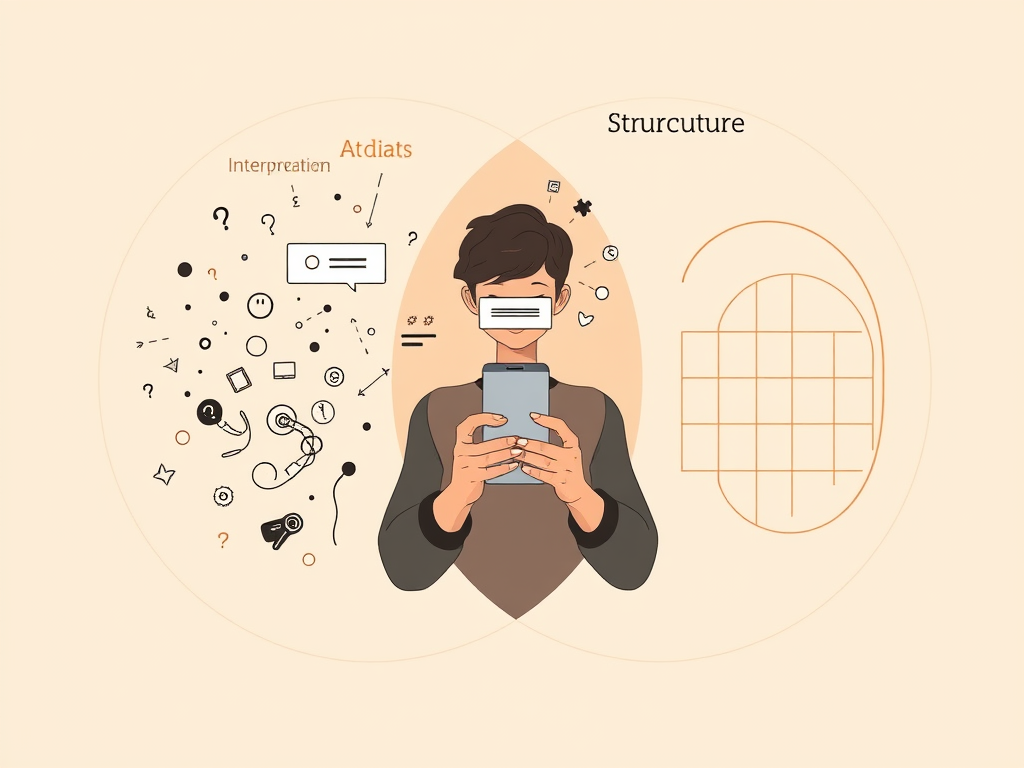
Paradigm friction in everyday AI use
When Thomas Kuhn published The Structure of Scientific Revolutions in 1962, he offered a now-familiar picture of how change happens in complex systems of knowledge. Paradigms do not fade politely. They persist, defend themselves, and continue to generate “normal science” long after anomalies have begun to accumulate. New paradigms do not replace the old overnight; they overlap, compete and coexist, often in the same institutions and even the same minds.
The current moment around large language models can be read in this light. On the surface, LLMs are entering organisations, phones and workflows as neutral tools. In practice, they are being absorbed almost entirely into the Interpretation paradigm that has dominated late-modern culture: a framework organised around self-analysis, optimisation, narrative identity and increasingly dense layers of reflection.
The Structure Research Studio works from a different hypothesis: that a Structure paradigm is emerging beneath this surface, and that AI is one of the pressure points where the friction between paradigms becomes easiest to feel.
This first journal entry outlines that tension and introduces a practical experiment: the Structure Vocabulary Builder, a meta-prompt designed to let this paradigm friction appear in everyday LLM use.
Paradigms in tension: Interpretation and Structure
Kuhn’s paradigms are not just theories; they are shared languages, exemplary problems and implicit standards of what counts as a “good” explanation. In the same way, contemporary culture operates within a loosely defined but powerful Interpretation paradigm:
- psychological and narrative explanations of the self
- the ideal of constant self-understanding and self-improvement
- productivity and optimisation as unquestioned goods
- a belief that enough insight and technique will bring life under control
LLMs have been deployed almost exclusively inside this framework.
They:
- draft personal brand statements
- optimise calendars and workflows
- refine therapeutic or coaching language
- accelerate content production and self-presentation
From a Kuhnian perspective, this is normal science: the new tool is used to extend and stabilise the existing paradigm.
Alongside this, a Structure paradigm is beginning to make itself felt. Its emphasis is different:
- less on “Who am I really?” and more on what patterns, constraints and loads are already present
- less on unlimited personal choice and more on the forms that actually shape action (economic, cognitive, temporal, linguistic)
- less on maximising output and more on recognising limits, saturation and enough
Where the Interpretation paradigm invites more introspection and more performance, the Structure paradigm asks more quietly:
What is the architecture of this situation?
What happens if the load is reduced instead of further optimised?
Which expectations are structurally impossible to satisfy?
The two paradigms are not commensurable in Kuhn’s sense. They use the same words—identity, freedom, progress—but mean different things by them. For that reason, the transition cannot be managed purely at the level of theory. It has to be felt in practice.
How paradigm friction feels in everyday AI use
The overlap between paradigms can be observed in a simple, familiar scene: a person takes out a phone, opens an LLM and types a question. Typical questions reflect the Interpretation paradigm:
- “How can I be more productive?”
- “Why do I always behave like this?”
- “How do I optimise my morning routine?”
- “Can you rewrite this so I sound more confident / authentic?”
The answers, too, tend to follow Interpretation-era patterns:
- more techniques, more routines, more explanatory models
- more refined narratives about “who I am” and “what my story is”
- more subtle pressure to perform, understand and manage every aspect of life
Many users report a paradoxical sensation: the more powerful the tools, the heavier everyday life begins to feel.
Kuhn would recognise this tension. Anomalies in a paradigm are first experienced not as arguments, but as discomfort: methods that once promised clarity now generate noise; additional refinements yield diminishing or even negative returns.
In the context of LLMs, that discomfort appears as:
- productivity tools that subtly increase anxiety
- self-analysis that generates more self-consciousness, not freedom
- decision support that multiplies options instead of clarifying constraints
The Structure Research Studio treats this discomfort as a signal that a different vocabulary is trying to surface.
A vocabulary problem before a technology problem
From this perspective, the main bottleneck is not the technical capability of LLMs.
It is the language we bring to them.
If the question is framed entirely within the Interpretation paradigm, the model will almost inevitably answer in that language:
- “better habits”,
- “better stories about yourself”,
- “better ways to manage everything you already try to do”.
The underlying structure remains untouched.
For this reason, the Studio’s work begins not with a new platform, product or interface, but with a vocabulary intervention: a way of shifting the language of interaction inside tools that already exist. This is the purpose of the Structure Vocabulary Builder.
The Structure Vocabulary Builder as meta-prompt
Technically, the Structure Vocabulary Builder is a meta-prompt: a long, carefully written system instruction that can be pasted into any LLM (ChatGPT, Claude and others).
Its function is simple:
- Users continue to ask their questions in whatever language comes naturally.
- The model is instructed to answer from the Structure paradigm as consistently as possible.
Concretely, the meta-prompt:
- downplays optimisation and personal branding
- resists harsh or absolute self-diagnoses
- questions fantasies of total control over time and outcome
- favours vocabulary around load, pattern, limit, simplification and “enough”
The model is not encouraged to become a therapist, a coach or an executive assistant.
It is framed instead as a shared space in which:
- the user’s lived situation,
- the model’s pattern-making capacity, and
- the implicit structure of the situation
can begin to correct one another.
This is, in Kuhn’s sense, a local experiment in incommensurability. The same surface questions are posed, but the underlying paradigm of the answer is shifted. The resulting friction—where the new vocabulary fits, where it clearly does not—becomes observable.
Cultural and scientific context
Positioned within its time, the Structure Vocabulary Builder sits at the crossing of several conversations:
- Business and productivity culture, which currently approaches AI primarily as a multiplier of output and a tool for personal efficiency.
- Psychological and therapeutic discourse, which tends to fold new technologies back into questions of self-understanding and identity.
- Philosophy of science and knowledge, where Kuhn’s insights on paradigms, anomalies and incommensurability remain central to understanding how frameworks shift.
The Studio’s contribution is modest but specific:
- To treat everyday AI use as a site of paradigm friction, not just a channel for automation.
- To build and test concrete linguistic instruments (meta-prompts, calibration protocols) that allow this friction to surface in ordinary interactions.
- To document, in this journal, what is learned about the transition from Interpretation to Structure as it actually unfolds in language.
Rather than claim a fully formed “new era”, the work assumes an overlapping period in which both paradigms coexist. The same device in a pocket can serve either framework, depending on the words that pass across its screen.
Method: from anomalies to patterns
Kuhn described how anomalies accumulate until they can no longer be ignored, pushing a field toward a new paradigm. The Structure Research Studio adopts a similar method at a smaller scale.
The Structure Vocabulary Builder is deployed as follows:
- users apply the meta-prompt to their own LLMs
- they use the model in daily life: drafting messages, thinking through situations, exploring decisions
- instead of sending raw transcripts, they report structured observations:
- where the new vocabulary genuinely reduced pressure or clarified structure
- where it failed and simply reproduced Interpretation-era patterns
- where it produced obvious distortions or misunderstandings
These observations are treated as anomalies and data points. The meta-prompt is then refined, tightened or relaxed, and redistributed.
Over time, the goal is not to stabilise a rigid doctrine, but to let a more adequate Structure vocabulary emerge: one that can operate inside business, personal and cultural contexts without collapsing back into familiar patterns of optimisation and self-interpretation.
Claiming a place in the conversation on a “New Era”
Discussions about a “new era” of AI and of culture often oscillate between hype and denial: either everything has changed, or nothing fundamental has shifted. Kuhn’s framework offers a more precise middle path:
- paradigms overlap,
- conflicts are initially linguistic and practical,
- and recognition often comes late, once new patterns of work and speech are already established.
By publishing this first journal entry under the name Structure Research Studio, Woodslope Cabin positions itself deliberately inside this conversation:
- as a research actor, not merely a commentator;
- as a builder of tools, not only of theories;
- and as a partner in dialogue with existing literature and practice, from Kuhn’s paradigm theory to contemporary organisational use of AI.
The central hypothesis is clear:
The transition from an Interpretation paradigm to a Structure paradigm will be felt first and most acutely in language – in the words people use when they reach for help, understanding or control, including through machines.
The Structure Vocabulary Builder is the Studio’s first instrument for testing that hypothesis in practice. This journal will continue to report on what is found there: the resistances, the misunderstandings, the small releases of pressure and clarity that indicate where a new paradigm is beginning to speak through old tools.